


The Cornell Text Messages
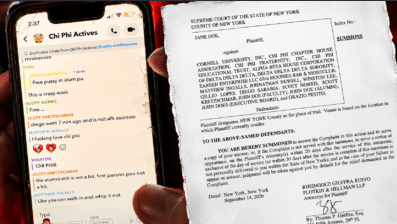
On November 7, 2026, The New York Times published dozens of text messages that Cornell University investigators gathered in a case that has drawn national attention. A former Cornell student, proceeding in court as Jane Doe, accuses seven members of the Chi Phi fraternity of sexually assaulting her at a party in October 2024. All seven deny wrongdoing, and none has been charged with a crime. According to NBC News, the Tompkins County District Attorney declined to bring charges in November 2024, based on a six-page statement in which she described some of the sexual conduct that night as consensual. After Jane Doe filed her lawsuit, the district attorney reopened the investigation. The New York attorney general’s office has subsequently taken over the case.
I have defended people accused of crimes for more than 30 years. I read these messages the way I would read discovery in one of my own cases, paying attention to the order in which they were sent and to what each one actually proves. This post sets out what I found.
Why I Refer to the Men as John Does
A judge has allowed the former student to pursue her lawsuit anonymously. The Times and other outlets have published the full names of the seven men. I have chosen not to repeat them here. None of them has been charged, and the prosecutor who first reviewed her account declined to bring charges. Their names are now tied to an accusation of gang rape in search results that will follow them for the rest of their lives, whatever a court eventually decides. I see no good reason for a person accused in a lawsuit to receive less protection than the person accusing him. In this post, I refer to the three men whose own messages I discuss as John Doe 1, John Doe 2, and John Doe 3.
What She Wrote in the First Week
Jane Doe’s texts in the week after the party are strong evidence that she consented to the encounter with John Doe 1 and John Doe 2. She told John Doe 1 that none of the sexual activity was illegal and that she “really liked” being with him and John Doe 2. She told John Doe 3 that they shared a “soul bond” and that the night was nothing to be ashamed of in private. She told John Doe 2 that people needed to grow up because attitudes toward sex were changing, and that she was “really open minded.”
These messages were written in her own words, to the men themselves, within days of the party. In a criminal trial, statements like these would be among the most important pieces of evidence in the case.
When Her Account Changed
Her account changed only after the story spread across campus. One week after the party, an anonymous post on a gossip forum joked that the fraternity’s members had been “gang banging.” Later that day, a second post called it a gang rape.
Five days before those posts appeared, she had used the same word herself. On October 21, she wrote to John Doe 1 that “anything anyone has to say about the gamgbang [sic] is out of their jurisdiction.” In the same message she wrote that none of them should feel any shame about it, and she added, “our body our choice.” She was describing the night as a gangbang, in her own words, and defending it as a choice she was entitled to make.
She later told campus investigators that the forum posts changed how she viewed what had happened. Her account also changed around the time the fraternity withdrew her invitation to its Halloween party. No message from the night itself records an objection. Her claim that she told John Doe 1 she was uncomfortable first appears in a text she sent two weeks after the party. As late as November 7, the day before she went to the police, she told John Doe 2 that people were “changing the narrative” because, in any sexual situation involving one woman and many men, people assume the woman was the victim.
The Texts Do Not Show She Was Unconscious
Her lawsuit alleges that she lost consciousness near the end of the night. Nothing in the text messages supports that claim. The messages show her conscious and communicating. She remembered snorting ketamine off John Doe 1. She also described another fraternity member telling her to take a few minutes before she got up, which suggests she was aware of what was happening late in the night.
Her gap in memory points to a blackout. A blackout affects memory. It does not mean a person was unconscious. Someone in a blackout can be awake, talk, act, and make choices, and then remember none of it the next day.
The Same Standard Applies to the Men
That point applies to every man in these exchanges. Jane Doe herself wrote that everyone that night was “confused, drunk, high, and nervous.” John Doe 1 wrote that his memory was fuzzy, that he and John Doe 2 were too impaired to control the situation, and that he had no memory of the ketamine episode. John Doe 3 wrote that he truly did not know what he had said when he walked into the room. The men’s messages in a fraternity group chat that night show they were functioning. A person in a blackout can also function, so those messages do not show that any of them understood what was happening better than she did.
Criminal Law and Campus Rules Treat Intoxication Differently
New York’s criminal law does not treat voluntary intoxication as the end of consent. Under Penal Law § 130.00(6), a person is “mentally incapacitated” by drugs or alcohol only when the substance was given to her without her consent. A person is “physically helpless” under § 130.00(7) when she is unconscious or otherwise physically unable to communicate unwillingness. Where there is no force and no incapacity, § 130.05(2) generally requires that the person clearly expressed her lack of consent in a way a reasonable person would have understood. Even when the prosecution’s theory is incapacity, § 130.10(1) gives the accused an affirmative defense if he did not know of the facts that made the other person incapable of consent.
Campus discipline works under a different set of rules. New York Education Law § 6441 requires every college in the state to adopt an affirmative consent standard. Under that standard, silence or lack of resistance does not show consent, and intoxication can make a person unable to consent depending on its degree. The statute also places the responsibility for obtaining consent on the person who initiates each sexual act, regardless of whether that person is under the influence of drugs or alcohol. Bills to bring a similar affirmative consent standard into the Penal Law have been introduced in Albany in several legislative sessions and have not passed.
That difference explains how one case can produce such different results. Cornell expelled two of the men and suspended two others under its campus standard. The District Attorney, applying the Penal Law, declined to charge anyone.
It also shows where the double standard lies. When adults voluntarily take the same substances, all of them remain functioning, and none of them expresses an objection, it is not defensible to hold only some of them responsible for missing a lack of consent that was never communicated. The campus rule does exactly that, because it assigns the burden to whoever initiated, however impaired that person was. Critics, including feminist scholars such as Harvard Law School professor Janet Halley and Northwestern professor Laura Kipnis, have argued that this approach is paternalistic toward women because it treats a woman’s choices while drinking or using drugs as less fully her own. On the record in this case, that criticism is well founded.
How Florida Law Compares
Florida’s sexual battery statute draws the same lines as New York’s criminal law. Under section 794.011(1), Florida Statutes, consent means “intelligent, knowing, and voluntary consent.” A person is “mentally incapacitated” by a narcotic or intoxicating substance only when it was administered without her consent. A person is “physically helpless” when she is unconscious, asleep, or for any other reason physically unable to communicate unwillingness. Florida colleges and universities, like those in New York, run their own disciplinary processes under their own policies. Students and parents in Miami-Dade, Broward, and Palm Beach counties should understand that a school can find a student responsible on facts that a prosecutor would never charge, and that a campus finding can be followed by a civil lawsuit and renewed attention from law enforcement, as happened here.
A Word as a Parent
Nothing in this post means I approve of what these young men did that night. My view is that the text messages do not support a finding of sexual assault. That is a separate question from whether the choices made in that house were good ones, and many of them were not.
As a father, I would be deeply troubled if my own child had been in that room. Snorting ketamine at a party is dangerous on its own. Group sex among people who are drunk and high makes it very hard for anyone to judge what anyone else wants. A group chat inviting other members to come watch or join, and a photograph of a young woman posted to that chat while it was happening, show a lack of respect for her that I would find hard to excuse in any son of mine.
Those choices also put everyone in that house at enormous risk, the young woman included, and two years later all of them are still living with the consequences. For her, the cost has been heavy. She has left Cornell. She now believes she was violated that night, and whether or not the law agrees with her, that belief is real to her. It will affect her for years to come, in her relationships and in how safe she feels, and no court ruling will change that. As for the men, two have been expelled, all seven have been sued, a grand jury may hear the case, and their names are permanently attached to an accusation of gang rape.
However this case ends, no one will come out of it a winner. If the lawsuit is dismissed and the grand jury declines to indict, the men still will not get their reputations back. If she prevails, whether in the civil case or through a criminal prosecution, no outcome will undo what she believes was done to her or the pain she has lived with since. Everyone in that room made choices that night that they cannot take back, and every one of them will carry that night with them long after the court proceedings are over.