


Criminal History and Federal Sentencing
If you or someone you love is being prosecuted in federal court, one of the first questions you probably have is: “How much time am I really looking at?”
In federal court, the answer often depends heavily on your criminal history.
At our Miami criminal defense firm, we regularly represent clients in federal cases involving drug trafficking, fraud, firearms offenses, white collar crimes, conspiracy charges, and more. One thing is always clear: your prior record can significantly affect your sentencing exposure under the federal system.
In this post, we’re going to explain:
- How criminal history affects federal sentencing
- What the Federal Sentencing Guidelines are
- How criminal history points are calculated
- What Criminal History Categories mean
- How prior convictions can increase mandatory minimums
- How we fight to reduce your sentencing exposure
If you’re under investigation or already indicted in federal court, this information could make a life-changing difference.
How Federal Sentencing Works in the United States
Federal sentencing is very different from sentencing in Florida state court.
In federal cases — including those prosecuted in the United States District Court for the Southern District of Florida — judges rely heavily on the United States Sentencing Guidelines.
These Guidelines are designed to create uniformity in sentencing across the country. While they are technically “advisory” after the U.S. Supreme Court’s decision in United States v. Booker, they still strongly influence the sentence a judge will impose.
Federal sentencing generally involves:
- Determining the Offense Level
- Calculating the defendant’s Criminal History Category
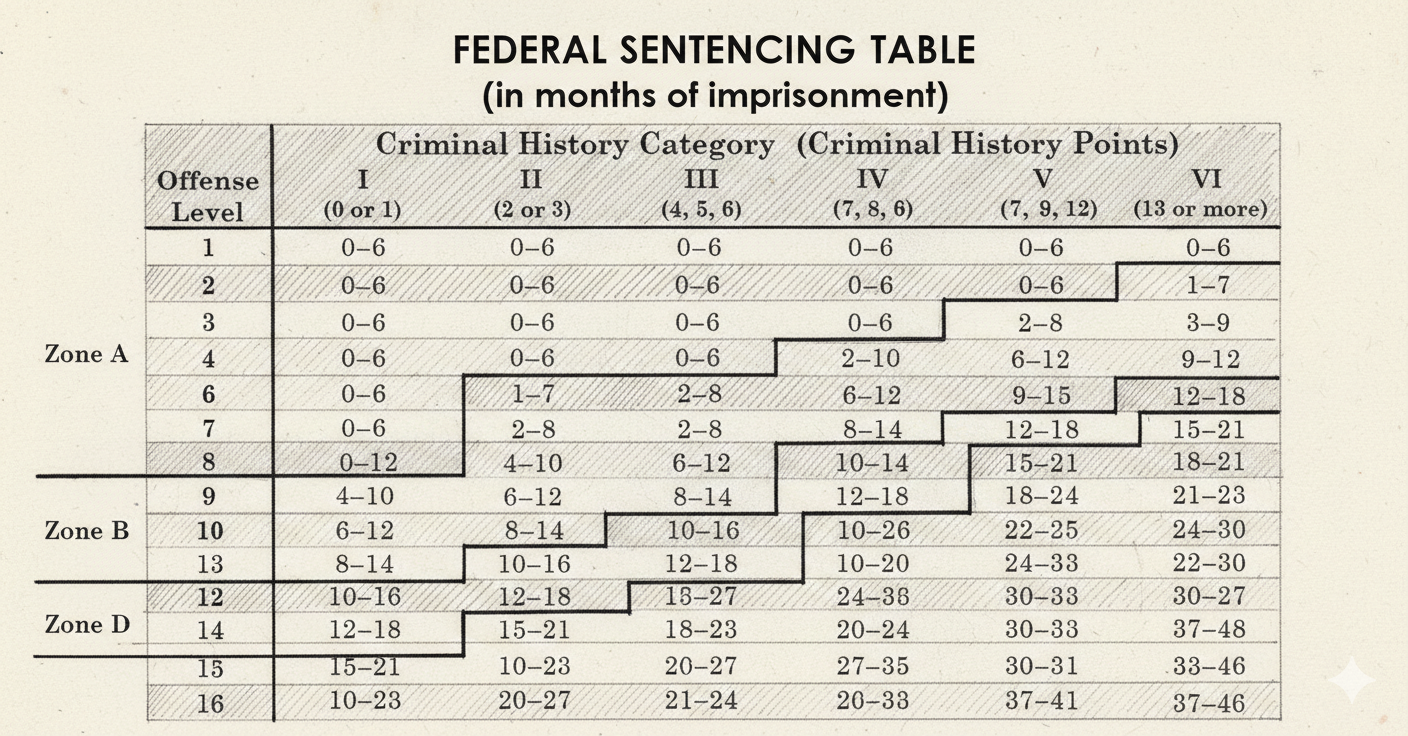
- Finding the advisory sentencing range on the Guidelines chart
Your prior convictions directly affect step two — and that can significantly increase your prison exposure.
What Is Criminal History Under the Federal Sentencing Guidelines?
Under the Guidelines, your criminal history is calculated using a point system. Each prior conviction is assigned points based on:
- Length of prior sentence
- Whether the sentence involved jail or prison
- How recent the conviction was
- Whether you were on probation, parole, or supervised release
The more points you accumulate, the higher your Criminal History Category.
There are six categories:
- Category I (least serious history)
- Category II
- Category III
- Category IV
- Category V
- Category VI (most serious history)
If you have little or no record, you may fall into Category I. But even a few prior convictions can quickly move you into higher categories — which can add years to your sentence.
How Criminal History Points Are Calculated
Here’s how federal criminal history points typically work:
3 Points
For each prior sentence of imprisonment exceeding 13 months.
2 Points
For each prior sentence of imprisonment of at least 60 days.
1 Point
For prior sentences not counted above (up to a total of 4 points).
Additional Points
You can receive:
- 2 points if you committed the federal offense while on probation, parole, or supervised release
- 1 point if the offense occurred within two years of release from custody
These calculations may sound straightforward — but in practice, they often aren’t.
We frequently challenge:
- Whether a prior conviction qualifies
- Whether multiple convictions should be counted separately
- Whether a prior case was constitutionally valid
- Whether juvenile adjudications should count
The difference of even one or two points can move you into a higher Criminal History Category — and that can mean substantially more time in federal prison.
How Criminal History Changes Your Federal Sentence
Let’s say your Offense Level is 26.
If you are:
- Category I → 63–78 months
- Category III → 78–97 months
- Category VI → 120–150 months
That is a dramatic difference — even though the offense level stays the same.
Now imagine you’re facing drug trafficking, wire fraud, healthcare fraud, firearm possession, or conspiracy charges in federal court here in Miami. If you already have prior convictions, your sentencing exposure increases quickly.
This is why early intervention by a federal criminal defense lawyer is so important.
Mandatory Minimum Sentences and Prior Convictions
In many federal drug cases, prior convictions can trigger enhanced penalties under 21 U.S.C. § 841.
For example:
- A prior “serious drug felony” can double a mandatory minimum sentence
- Multiple qualifying prior convictions can increase mandatory minimums even further
The government must follow specific procedures to seek these enhancements, including filing what’s commonly known as a “851 notice.”
If we can successfully challenge the prior conviction or prevent the enhancement from being filed, we may significantly reduce your exposure.
The Career Offender Enhancement
One of the most severe consequences of prior convictions under the Guidelines is the Career Offender designation.
If:
- You are at least 18 at the time of the offense
- The federal offense is a felony drug offense or crime of violence
- You have at least two prior felony convictions for drug offenses or crimes of violence
You may be classified as a Career Offender under the Guidelines.
This can:
- Automatically increase your Criminal History Category to VI
- Substantially raise your Offense Level
- Result in dramatically higher sentencing ranges
We regularly analyze whether prior convictions actually qualify under current federal law. Many older convictions do not meet the technical definitions required under recent court decisions.
Juvenile Convictions and Federal Sentencing
Many clients are shocked to learn that juvenile cases can count in federal sentencing.
Depending on:
- The nature of the offense
- The sentence imposed
- How recent the adjudication was
Juvenile matters may add criminal history points.
However, not all juvenile cases qualify. This is another area where careful legal analysis can reduce your exposure.
When Criminal History Overstates Your Record
Sometimes the Guidelines exaggerate the seriousness of your prior record.
For example:
- Multiple minor offenses in a short time period
- Very old convictions
- Non-violent conduct
- Cases where you received minimal punishment
In these situations, we can ask the federal judge for a downward departure or variance, arguing that your Criminal History Category overstates the seriousness of your background.
Judges in the Southern District of Florida have discretion to impose sentences below the advisory range when supported by strong mitigation arguments.
The Role of Federal Plea Agreements
Most federal cases resolve through plea agreements. Your criminal history can influence:
- Whether the government offers a plea
- Whether they seek sentencing enhancements
- Whether you qualify for the “safety valve”
- Whether you receive acceptance of responsibility reductions
The federal “safety valve” provision allows certain non-violent drug offenders with limited criminal history to avoid mandatory minimum sentences.
If your criminal history is minimal, we may be able to position you to qualify — potentially saving years of incarceration.
Why Early Legal Representation Matters
If you are under federal investigation in Miami — whether by the FBI, DEA, ATF, or another federal agency — do not wait until indictment to hire counsel.
Early representation allows us to:
- Review your prior record
- Anticipate sentencing exposure
- Identify enhancement risks
- Communicate with federal prosecutors
- Strategically position your case
Federal sentencing is not something you want to leave to chance.
Federal Sentencing Is Technical — But It’s Also Strategic
While the Guidelines provide structure, federal sentencing advocacy is far more than math.
We present:
- Mitigation evidence
- Character letters
- Employment history
- Family responsibilities
- Rehabilitation efforts
- Mental health or substance abuse treatment history
Federal judges look at the broader factors outlined in 18 U.S.C. § 3553(a), not just the Guidelines.
Your criminal history matters — but it does not define you.
Facing Federal Charges in Miami? Let’s Talk About Your Record.
If you are facing federal drug charges, white collar allegations, firearm offenses, conspiracy charges, or fraud charges in South Florida, your criminal history will play a major role in your sentencing exposure.
We analyze every prior conviction carefully. We look for opportunities to:
- Reduce criminal history points
- Challenge qualifying offenses
- Avoid enhancements
- Argue for downward variances
- Position you for the lowest possible sentence
Federal court is different from state court. The stakes are higher. The procedures are stricter. The consequences are longer.
When your freedom is on the line, you need a federal criminal defense team that understands how criminal history interacts with the Federal Sentencing Guidelines — and how to fight back strategically.
If you or someone you care about is under investigation or has been charged in federal court in Miami, contact our office immediately for a confidential consultation. The earlier we get involved, the more options we may have to protect your future.
CALL US NOW for a CONFIDENTIAL INITIAL CONSULTATION at (305) 538-4545, or take a moment to fill out our confidential and secure intake form.* The additional details you provide will greatly assist us in responding to your inquiry.
*Due to the large number of inquiries we receive, providing specific details about your case helps us respond promptly and appropriately.
THERE ARE THOUSANDS OF LAW FIRMS AND ATTORNEYS IN SOUTH FLORIDA. ALWAYS INVESTIGATE A LAWYER’S QUALIFICATIONS AND EXPERIENCE BEFORE MAKING A DECISION ON HIRING A CRIMINAL DEFENSE ATTORNEY FOR YOUR MIAMI-DADE COUNTY CASE.