


Relevant Conduct in Federal Sentencing
If you are facing federal charges in Miami, you might assume your sentence will be based only on the specific offense listed in your indictment.
That assumption can cost you years.
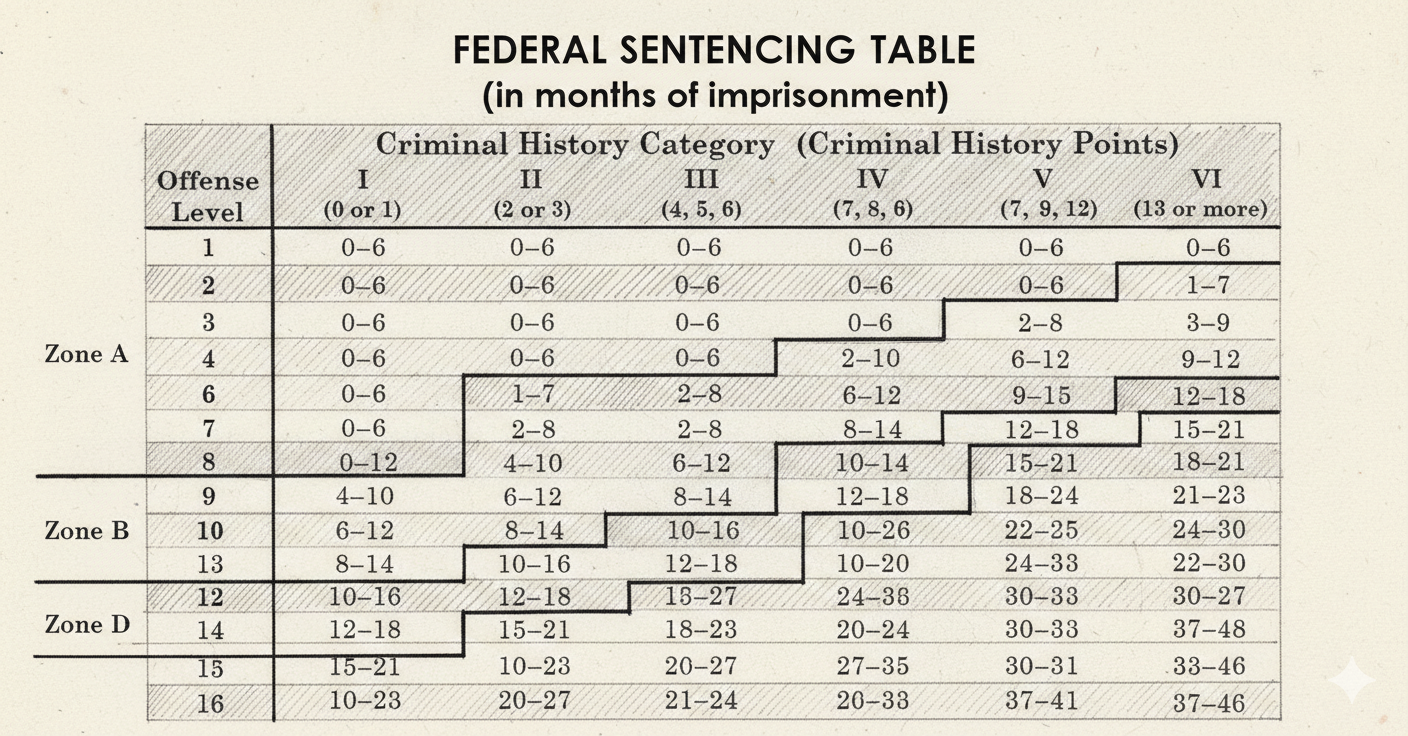
Under the concept of relevant conduct in federal sentencing, a judge may consider far more than just the conduct underlying the count of conviction when calculating your advisory range under the Federal Sentencing Guidelines.
As federal criminal defense lawyers practicing in the Southern District of Florida, we routinely explain this issue to clients who are surprised to learn how broad federal sentencing exposure can become.
If you are under investigation or charged in federal court, understanding relevant conduct is not academic. It directly impacts your freedom.
What Is Relevant Conduct Under the Federal Sentencing Guidelines?
Relevant conduct is governed by U.S.S.G. § 1B1.3, promulgated by the United States Sentencing Commission.
- All acts and omissions you committed, aided, abetted, counseled, commanded, induced, procured, or willfully caused
- Certain acts of others in jointly undertaken criminal activity
- Conduct occurring during the offense of conviction
- Conduct in preparation for that offense
- Conduct undertaken to avoid detection or responsibility
This means your sentencing range may reflect behavior beyond the narrow wording of the indictment.
Federal sentencing is advisory after Booker, but the Guidelines still heavily influence most sentences imposed in Miami federal court.
How Relevant Conduct Expands Sentencing Exposure
Imagine you plead guilty to one count of distributing 50 grams of cocaine.
If the government proves that additional transactions were part of the same course of conduct or common scheme, the judge may aggregate those quantities when calculating your base offense level.
- Increase your guideline range
- Trigger statutory mandatory minimums (if admitted or found by a jury)
- Raise your supervised release exposure
The government only needs to prove most disputed sentencing facts by a preponderance of the evidence, not beyond a reasonable doubt.
Relevant Conduct in Federal Drug Cases
In federal drug cases, relevant conduct most often centers on drug quantity.
- Drug quantity determines the base offense level
- Multiple transactions can be aggregated
- Uncharged conduct may be included if it qualifies as the same course of conduct or common scheme
In South Florida, federal drug conspiracy indictments frequently involve sweeping allegations. A defendant who handled small quantities may still face exposure tied to broader conduct if the government meets its burden.
Relevant Conduct in Federal Fraud and White-Collar Cases
In fraud cases, relevant conduct typically revolves around loss amount and number of victims.
Even if you plead guilty to one transaction, the court may consider the broader scheme if it qualifies as relevant conduct.
2024 Loss Calculation Update
Recent amendments clarified that intended loss remains an available measure where appropriate, not just actual loss.
We routinely litigate loss calculations because even a modest adjustment can shift the advisory range by years.
Acquitted Conduct: What Changed in 2024
For decades, judges could consider conduct for which a defendant was acquitted when calculating the Guidelines range.
Effective November 1, 2024, § 1B1.3 was amended to provide that relevant conduct does not include conduct for which the defendant was criminally charged and acquitted in federal court, unless that conduct establishes, in whole or in part, the offense of conviction.
- Acquitted conduct can no longer increase your advisory Guidelines range.
- The court cannot use acquitted counts to drive offense level calculations.
However, under 18 U.S.C. § 3661, courts retain discretion to consider information about a defendant’s background and conduct when determining the ultimate sentence under the § 3553(a) factors.
Relevant Conduct in Conspiracy Cases: Scope Matters
Conspiracy cases create serious exposure — but there are limits.
To attribute co-conspirator conduct under § 1B1.3(a)(1)(B), the government must prove:
- The conduct was within the scope of the jointly undertaken criminal activity
- It was in furtherance of that activity
- It was reasonably foreseeable to you
All three are independent requirements.
Merely being charged in a conspiracy does not automatically make you responsible for everything others did.
We frequently litigate scope disputes in federal drug and fraud conspiracies because prosecutors often attempt to expand attribution beyond what the law permits.
The Presentence Investigation Report (PSR) Process
After conviction or plea, a probation officer prepares a Presentence Investigation Report (PSR).
You have the right to decline or limit that interview. However, we always attend the PSR interview with our clients and carefully manage the scope of questioning, particularly when acceptance of responsibility under § 3E1.1 is at issue. A complete refusal without strategic planning can sometimes jeopardize a potential 2- or 3-level reduction.
The PSR includes:
- Guideline calculations
- Relevant conduct findings
- Criminal history scoring
- Enhancement recommendations
We file formal objections when appropriate and litigate disputed findings when necessary.
Evidence at Federal Sentencing
Federal sentencing hearings operate under relaxed evidentiary rules compared to trial.
Hearsay evidence is admissible.
However, under § 6A1.3 of the Guidelines, any information relied upon must have sufficient indicia of reliability to support its probable accuracy.
In practice, that means:
- Cooperating witness statements can be challenged
- Law enforcement summaries can be contested
- Inflated loss or drug calculations can be attacked
When relevant conduct significantly affects the advisory range, we request evidentiary hearings and require the government to meet its burden.
Why Relevant Conduct Makes Federal Charges So Serious
If you are under federal investigation in Miami, you are not just defending the count listed in the indictment.
You are defending the broader narrative the government will present at sentencing.
Relevant conduct allows prosecutors to attempt to:
- Increase drug quantities
- Expand fraud loss amounts
- Broaden conspiracy attribution
- Seek enhancements
And they need only prove most disputed factors by a preponderance of the evidence.
Understanding this from the beginning changes plea negotiations, litigation strategy, and sentencing preparation.
Before You Sign Any Federal Plea Agreement
Plea agreements often contain:
- Stipulated drug quantities
- Agreed loss calculations
- Enhancement concessions
- Appeal waivers
Not all agreements protect you from expanded relevant conduct arguments.
Before signing, you should understand:
- What conduct you are admitting
- What conduct the government may still argue
- Whether stipulations are binding
- How the Guidelines will be calculated
We analyze every clause because sentencing exposure often turns on language most people overlook.
Speak With a Miami Federal Criminal Defense Lawyer
If you are facing federal drug charges, fraud allegations, conspiracy counts, or any other federal offense in the Southern District of Florida, you need to understand how relevant conduct may affect your sentencing exposure.
The Guidelines are technical.
The amendments are evolving.
The consequences are real.
We represent clients in federal court throughout Miami and South Florida. If you are under investigation or already charged, contact our office for a confidential consultation.
Your defense strategy must account for relevant conduct from day one.
CALL US NOW for a CONFIDENTIAL INITIAL CONSULTATION at
(305) 538-4545, or take a moment to fill out our confidential and secure intake form.* The additional details you provide will greatly assist us in responding to your inquiry.
*Due to the large number of inquiries we receive, providing specific details about your case helps us respond promptly and appropriately.
THERE ARE THOUSANDS OF LAW FIRMS AND ATTORNEYS IN SOUTH FLORIDA. ALWAYS INVESTIGATE A LAWYER’S QUALIFICATIONS AND EXPERIENCE BEFORE MAKING A DECISION ON HIRING A CRIMINAL DEFENSE ATTORNEY FOR YOUR MIAMI-DADE COUNTY CASE.