



Federal Presentence Investigation Reports
If you are awaiting sentencing in federal court, one document will shape what happens next more than almost anything else: the federal presentence investigation report, commonly called the “PSR” or “PSI.”
We have seen this document determine whether someone receives probation or years in federal prison. We have seen it affect security classification, program eligibility, and even immigration consequences. And we have seen small errors in a PSR add significant time to a sentence.
As federal practitioners appearing regularly in the United States District Court for the Southern District of Florida, we treat the presentence investigation report as a critical stage of your defense — not a formality.
Below, we explain how the federal PSR process works, how objections are handled, how the Federal Sentencing Guidelines are calculated, and what recent changes to white-collar loss calculations mean for defendants.
What Is a Federal Presentence Investigation Report?
A federal presentence investigation report (PSR) is a detailed report prepared by a United States Probation Officer after you plead guilty or are found guilty at trial in federal court.
The report is required under Rule 32 of the Federal Rules of Criminal Procedure. Its purpose is to provide the sentencing judge with a comprehensive picture of:
- The offense conduct
- Your criminal history
- The advisory Federal Sentencing Guidelines calculation
- Victim impact
- Financial condition
- Personal history and characteristics
Although the Guidelines are advisory after United States v. Booker, federal judges must still properly calculate the guideline range before imposing a sentence. In practice, the PSR becomes the framework for that calculation.
How the Federal Presentence Investigation Process Works
1. Assignment to a U.S. Probation Officer
After conviction or plea, the court orders a presentence investigation. A U.S. Probation Officer is assigned to prepare your report. In Miami, this comes from the probation office attached to the Southern District of Florida. Probation officers are officers of the court — not prosecutors — but they rely heavily on investigative reports and information provided by the government.
2. The Presentence Interview
You will be scheduled for a presentence interview. This is one of the most consequential conversations you will have before sentencing. The probation officer will ask about:
- Your role in the offense
- Prior arrests and convictions
- Education and employment history
- Family background
- Physical and mental health
- Substance use history
- Financial assets and liabilities
You have the right to have your attorney present during this interview. We strongly advise our clients never to attend alone.
What you say can directly affect acceptance of responsibility, obstruction of justice enhancements, role adjustments (leader, organizer, minor participant), and relevant conduct findings. Preparation matters. A poorly handled interview can increase your guideline range.
What Is Included in a Federal PSR?
Federal presentence reports are detailed. In serious cases, they often exceed 30 pages.
Offense Conduct Section
This section summarizes the alleged facts of the case, typically drawing from the indictment, the plea agreement, discovery materials, law enforcement reports, and co-defendant statements. In conspiracy cases — especially drug trafficking and fraud — this section may include relevant conduct beyond the count of conviction. That can significantly increase your sentencing exposure.
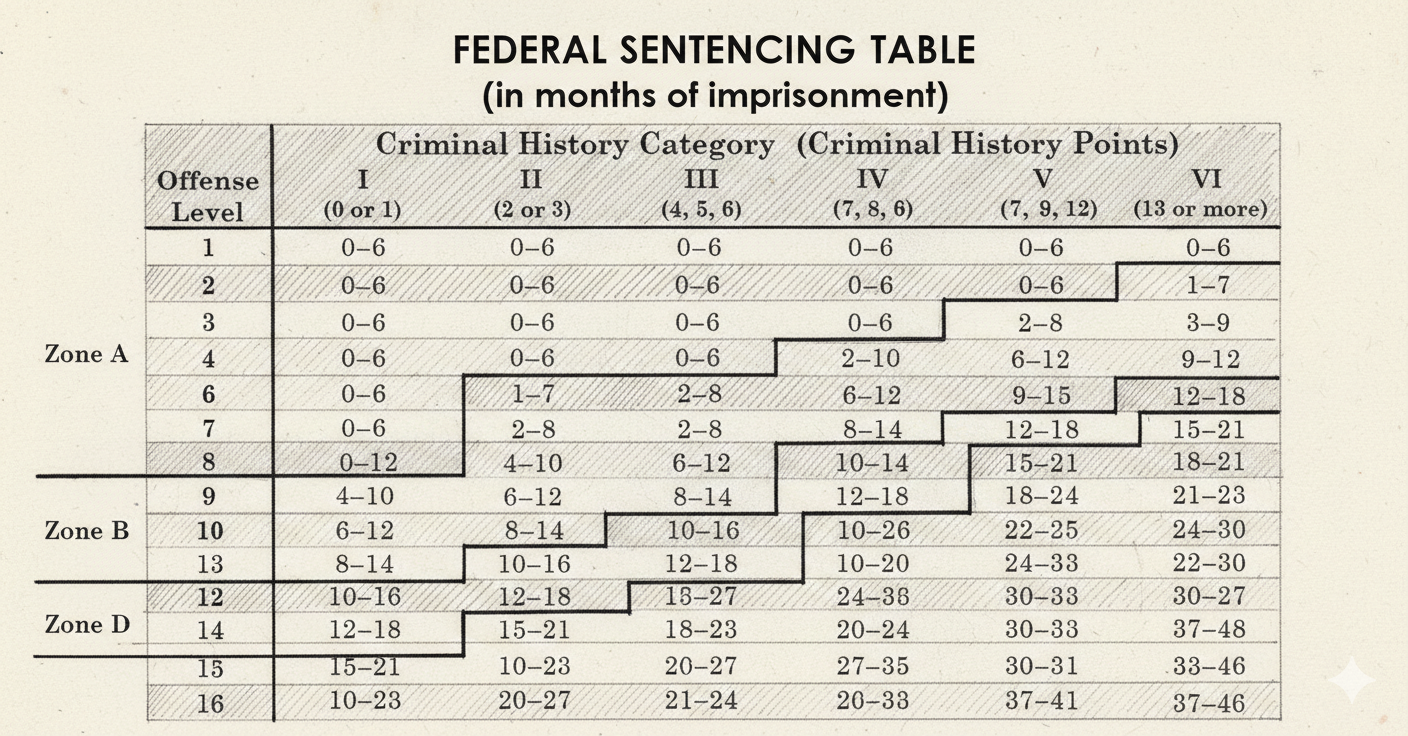
Federal Sentencing Guidelines Calculation
The PSR calculates your advisory guideline range using the United States Sentencing Guidelines. The calculation includes:
- Base offense level
- Specific offense characteristics
- Enhancements (leadership, obstruction, sophisticated means, firearm involvement, etc.)
- Acceptance of responsibility reduction
- Criminal history category
Even though the Guidelines are advisory, judges must calculate them correctly before considering the sentencing factors in 18 U.S.C. § 3553(a).
The § 3553(a) Factors
At sentencing, the court considers the nature and circumstances of the offense, history and characteristics of the defendant, need for deterrence, protection of the public, rehabilitation, and avoiding unwarranted sentencing disparities. A strong mitigation presentation can result in a downward variance below the advisory range.
Criminal History Calculation
Your criminal history category is determined by assigning points to prior convictions. Common issues we challenge include old convictions improperly counted, cases that should be treated as related, minor offenses inflating the score, and incorrect assessment of probation violations. Moving from Criminal History Category I to II or III can add years to a federal sentence. Accuracy here is not optional.
The 14-Day Objection Deadline — Timing Matters
After the probation officer completes the draft PSR, it is disclosed to the parties. Under Rule 32(f)(1), written objections must be filed within 14 days of receiving the draft PSR. This deadline runs from disclosure of the report — not from the plea hearing or any other event.
If objections are not filed, the sentencing judge will generally accept those factual statements as true for sentencing purposes. In federal court, failing to object can effectively make those facts undisputed.
We review every PSR line by line with our clients before filing objections.
Litigation of PSR Objections
After objections are submitted, the probation officer may revise the report. Unresolved disputes are addressed at sentencing, the court may hold an evidentiary hearing, and the judge makes findings of fact on disputed issues. Guideline disputes are common in the Southern District of Florida, especially in drug conspiracies, healthcare fraud, PPP fraud, and firearms cases.
Presentence Reports in Drug Cases
Drug cases often turn on quantity findings. In federal court, conspiracy liability can include drugs attributable to others, relevant conduct may extend beyond the charged count, and firearm enhancements can apply even without a firearm conviction. Disputing drug weight or role enhancements can significantly reduce the offense level. Safety valve eligibility may also depend on accurate factual findings in the PSR.
Presentence Reports in Federal Fraud Cases
In white collar cases, the primary driver of the guideline range is often loss amount under U.S.S.G. §2B1.1. Loss can include actual loss, intended loss, and relevant conduct beyond the charged counts.
2023 Amendment to the Loss Table
In 2023, the Sentencing Commission adopted Amendment 816, which adjusted the loss table thresholds to account for inflation. This change revised the monetary brackets that trigger offense level increases in fraud cases. For defendants sentenced under the current Guidelines, these updated thresholds can materially affect offense level calculations. In South Florida healthcare fraud and wire fraud cases, even small adjustments to loss figures can alter the guideline range substantially.
We frequently work with forensic accountants when necessary to challenge overstated loss amounts.
Bureau of Prisons Consequences of the PSR
Your PSR does not disappear after sentencing. The Federal Bureau of Prisons relies heavily on the report to determine:
- Security classification
- Facility designation
- Eligibility for RDAP (Residential Drug Abuse Program)
- First Step Act earned time credits
- Halfway house placement
- Immigration detainers
Language in the PSR describing you as a leader, organizer, or violent offender can influence prison placement and program eligibility. We consider long-term BOP implications when drafting objections.
Immigration Consequences
If you are not a U.S. citizen, statements made during the presentence process can impact removal proceedings, eligibility for relief, and future admissibility. Careful handling of offense conduct descriptions and admissions is especially important in these cases.
Allocution and Sentencing Advocacy
Beyond the PSR itself, you have the right to address the court at sentencing — known as allocution. A well-prepared allocution, combined with character letters, employment records, medical documentation, and evidence of rehabilitation, can influence how the court applies the § 3553(a) factors. Federal sentencing is not mechanical. Judges in Miami exercise discretion. Effective advocacy matters.
Why Experienced Federal Sentencing Counsel Matters
The federal presentence investigation report affects your advisory guideline range, whether enhancements apply, your criminal history category, your Bureau of Prisons classification, your immigration status, and your restitution obligations.
We do not treat the PSR as paperwork. We treat it as one of the most strategic stages of your case. In federal court, small guideline adjustments can translate into years of your life.
If you are facing federal sentencing in Miami or anywhere in the Southern District of Florida, you need defense counsel who understands Rule 32 procedure, Eleventh Circuit sentencing practice, and the current Sentencing Guidelines — including recent amendments that impact white collar cases.
If you would like a confidential evaluation of how the PSR process may affect your specific case, contact our office to discuss your situation.
CALL US NOW for a CONFIDENTIAL INITIAL CONSULTATION at (305) 538-4545, or take a moment to fill out our confidential and secure intake form.* The additional details you provide will greatly assist us in responding to your inquiry.
*Due to the large number of inquiries we receive, providing specific details about your case helps us respond promptly and appropriately.
THERE ARE THOUSANDS OF LAW FIRMS AND ATTORNEYS IN SOUTH FLORIDA. ALWAYS INVESTIGATE A LAWYER’S QUALIFICATIONS AND EXPERIENCE BEFORE MAKING A DECISION ON HIRING A CRIMINAL DEFENSE ATTORNEY FOR YOUR MIAMI-DADE COUNTY CASE.