


Understanding the Federal Sentencing Guidelines
When you’re facing a federal criminal charge—whether it’s fraud, drug trafficking, firearm possession, or anything else in the federal system—you quickly find out that the process looks nothing like state court. One of the biggest differences? The Federal Sentencing Guidelines. If you or someone you care about is under investigation or has been indicted, you’ve probably already heard prosecutors, judges, or even your own research mention these “guidelines.”
And if you’re like most people, you’re probably wondering: What exactly are the Federal Sentencing Guidelines, and how will they affect my case?
As federal criminal defense lawyers based in Miami, we guide clients through this system every day. Our purpose in this post is to explain what the Federal Sentencing Guidelines are, why they matter, how they are applied, and—most critically—how we can invoke them strategically to advocate for a more favorable outcome in your case.
What Are the Federal Sentencing Guidelines?
The Federal Sentencing Guidelines are a massive, complex set of rules created by the U.S. Sentencing Commission. They’re designed to give federal judges a framework for sentencing people convicted of federal crimes. The idea behind them was consistency—making sure similar defendants committing similar crimes receive similar sentences across the country.
Even though the guidelines were previously mandatory, they are now advisory following the Supreme Court’s decision in United States v. Booker (2005). But “advisory” doesn’t mean “optional.” Judges still rely heavily on them, and prosecutors use them aggressively to calculate recommended sentences.
In reality, they often set the starting point—and sometimes the ending point—for the sentence in your case.
Why the Guidelines Matter So Much in Your Case
You might think your sentence will depend mostly on the judge, the facts of your case, and how your lawyer presents your defense. And while all of that is true, the guidelines play a significant role.
Here’s why they matter:
- They generate a recommended sentencing range in months.
- Judges must calculate that range before imposing sentence.
- Prosecutors structure plea offers around them.
- Probation officers create a Presentence Investigation Report (PSR) based on them.
- Mitigation, cooperation, and objections all hinge on where you fall in the guidelines table.
In other words, if you don’t understand where you land in the guidelines, you don’t understand your exposure.
How the Guidelines Work: Offense Level & Criminal History
To understand the guidelines, you need to understand two major components:
- Offense Level
- Criminal History Category
The intersection of these two numbers gives you your recommended sentencing range.
1. Determining Your Offense Level
Every federal offense starts with a base offense level—a number assigned depending on the type of crime. From there, you can go up or down through “adjustments,” “enhancements,” and “reductions.”
Common Enhancements You Need to Know About
These are some of the most frequent enhancements we see in Miami federal cases:
- Role enhancements (accused of being an organizer, leader, or supervisor)
- Loss amount enhancements (especially in fraud, wire fraud, bank fraud, Medicare fraud, PPP fraud, etc.)
- Drug quantity enhancements
- Firearm enhancements
- Obstruction of justice enhancements
- Computer-related enhancements
Each enhancement increases your offense level, sometimes dramatically. For example, a fraud case involving alleged losses over $550,000 can add 14 levels, which can easily be the difference between probation and prison.
Reductions That Can Lower Your Offense Level
Fortunately, some reductions can work in your favor:
- Acceptance of responsibility (usually 2–3 levels off)
- Safety valve (for some drug cases)
- Minor or minimal role adjustments
- Cooperation with the government (often results in a downward departure)
These reductions are where an experienced federal defense lawyer becomes invaluable. We analyze every detail of your case to argue for the lowest possible offense level.
2. Your Criminal History Category
The guidelines don’t just look at your offense—they also evaluate your past. Your criminal history points are added up and placed into one of six categories (I through VI).
- Category I = little or no prior record
- Category VI = extensive criminal history
This category can bump you into a significantly higher sentencing range, even if your offense level remains the same.
For example, two defendants with the same offense level can have dramatically different outcomes if one is Category I and the other is Category V.
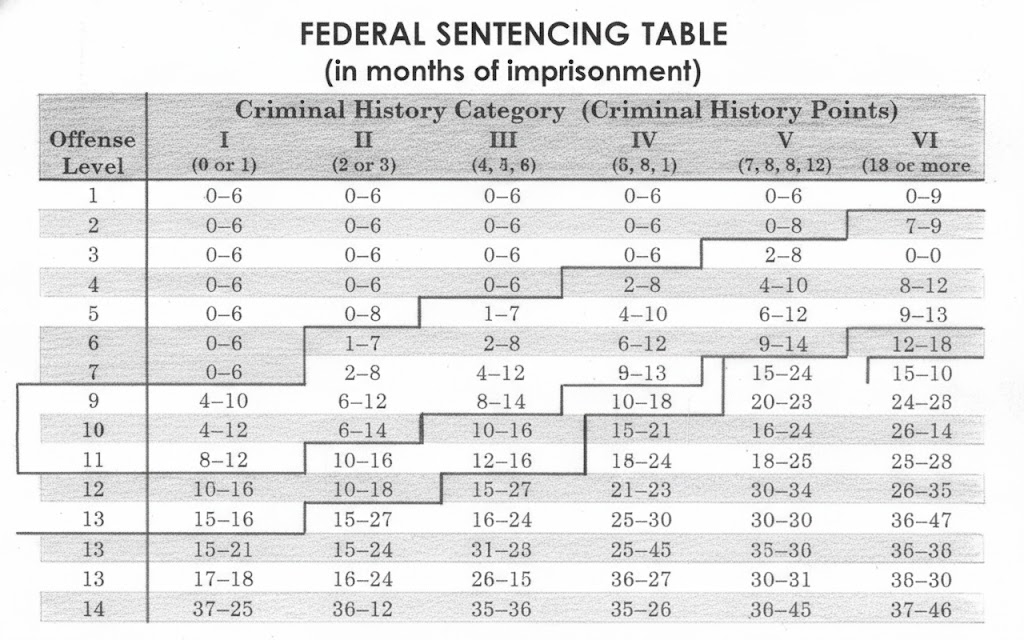
The Sentencing Table: Where the Numbers Come Together
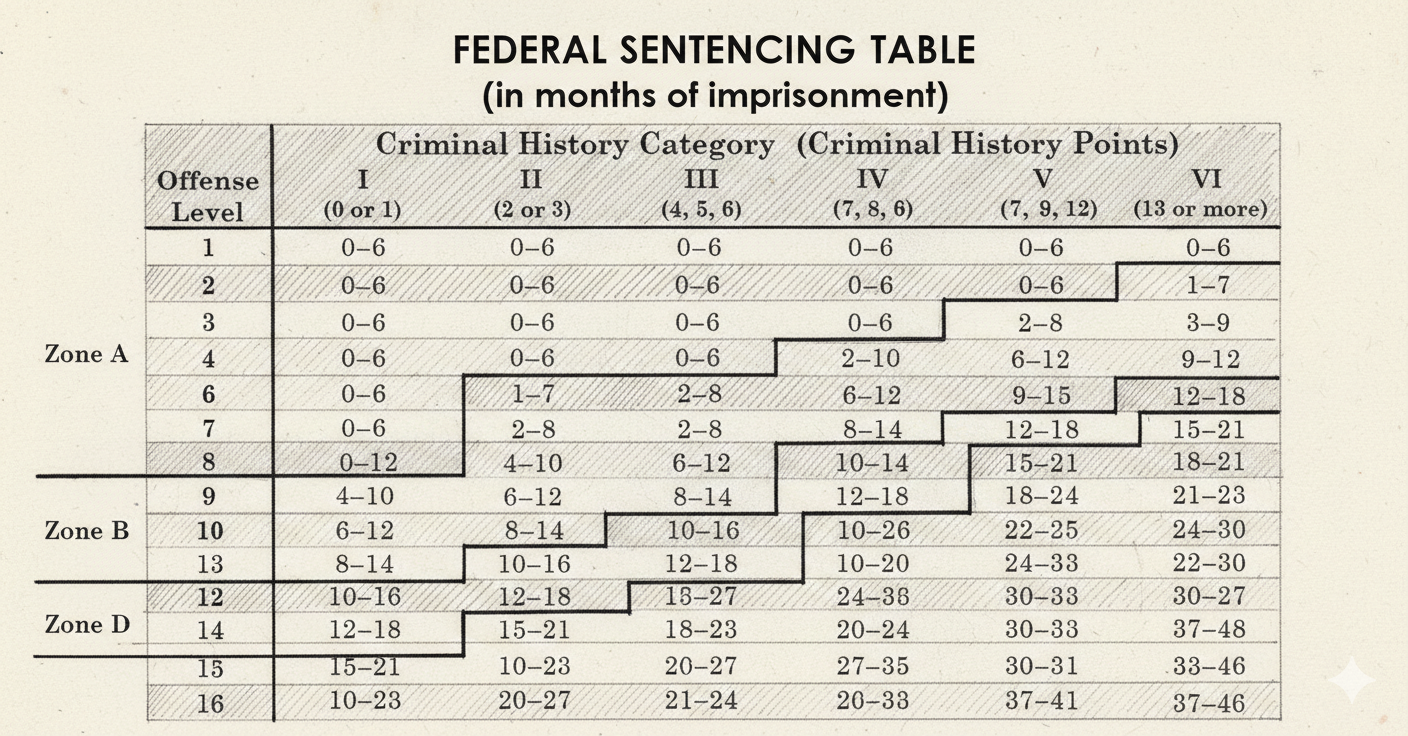
Once we calculate your offense level and your criminal history category, we look at the Sentencing Table, a large grid that shows the recommended sentencing range in months.
Example:
- Offense Level: 22
- Criminal History Category: II
- Guideline Range: 46–57 months
That range becomes the judge’s starting point.
Mandatory Minimums vs. the Guidelines
One of the most important things you need to know is that mandatory minimum sentences override the guidelines.
So if your case involves:
- 5-year mandatory minimums (common in drug cases)
- 7-year mandatory minimums (brandishing a firearm under §924(c))
- 10-year mandatory minimums
- 15-year mandatory minimums
- 25-year stacking mandatory minimums
…the judge must impose at least that minimum, even if the guidelines say otherwise—unless we can qualify you for relief, such as:
- Safety valve
- Substantial assistance motion (5K1.1)
- Rule 35 reduction
These can be game-changers.
How Judges Use the Guidelines Today
Even though the guidelines are “advisory,” judges devote significant attention to them because:
- The law requires them to calculate and consider the guideline range.
- Appellate courts often look to the guidelines to determine whether a sentence is reasonable.
- Judges generally want to ensure consistency, and guidelines provide a framework.
However, judges can depart or vary from the guidelines for many reasons, such as:
- The defendant’s personal history and characteristics
- Lack of criminal history
- Mental health issues
- Childhood trauma
- Overstated loss amounts
- Disproportionate enhancements
- Sentencing disparities among co-defendants
- Cooperation (formal or informal)
- Extraordinary rehabilitation
We routinely craft mitigation strategies that highlight these factors to persuade judges to go below the recommended range.
The Presentence Investigation Report (PSR): Your Silent Sentencing Weapon
Before sentencing, a probation officer prepares the PSR, which includes:
- Your background
- Your criminal history
- Details of the offense
- The guideline calculation
- Sentencing recommendations
The PSR is hugely influential. Judges rely on it heavily.
This is why we never let clients go through the PSR interview alone. We prepare you, guide you, and ensure the information presented is accurate and helpful—not harmful.
We also file objections to incorrect or unfair guideline calculations. A well-argued objection can significantly reduce your guideline range.
How We Use the Guidelines Strategically in Your Defense
The guidelines are technical, but they’re also full of opportunities—if your lawyers know what to look for.
Here are some ways we use the guidelines to your advantage:
- Challenging Loss Amounts and Drug Quantities
The government often inflates these. Challenging them can shave off major enhancements. - Arguing for Role Reductions
If prosecutors want to label you a leader or organizer, we push back hard. - Applying Safety Valve
This can remove mandatory minimums and reduce your offense level. - Negotiating Better Plea Agreements
We use guideline analysis to show prosecutors why their calculations are wrong or excessive. - Preparing Powerful Sentencing Memoranda
We humanize you, highlight your positive history, and present mitigation evidence that guidelines don’t capture. - Seeking Downward Departures or Variances
We argue the guidelines are overly harsh or unfairly applied. - Using Cooperation When Appropriate
If cooperation is in your best interest, we negotiate formal and informal cooperation agreements strategically to protect you.
Why Miami Federal Cases Often Involve Harsh Guideline Calculations
South Florida is one of the busiest federal districts in the country. The U.S. Attorney’s Office in Miami prosecutes massive:
- Healthcare fraud cases
- Drug trafficking cases
- Money laundering cases
- Firearms cases
- Immigration offenses
- Cybercrime and wire fraud cases
These cases frequently involve high guideline calculations because:
- Fraud cases trigger huge loss enhancements.
- Drug cases trigger quantity enhancements.
- Firearm cases trigger mandatory minimums.
- Multi-defendant conspiracy cases trigger role enhancements.
This is why you need a defense team that handles these cases every day. You don’t want to learn the federal system through trial and error.
What You Should Do If You’re Facing Federal Sentencing
If you’re already convicted or you’ve taken a plea, sentencing is your next—and possibly your most important—phase. Here’s what we tell our clients:
- Don’t panic—but don’t wait.
Time matters. Mitigation takes work. - Be completely honest with us.
Everything in your life can become helpful mitigation—if we know about it. - Don’t talk to probation alone.
The PSR is extremely influential. We will guide you through it. - Start preparing for sentencing early.
Letters, evaluations, treatment records, employment history, and personal background all help us build a compelling narrative. - Understand your guideline calculation.
We break down your offense level, enhancements, and criminal history so you know exactly what we’re fighting.
Final Thoughts: The Guidelines Don’t Control Your Future—But They Shape It
The Federal Sentencing Guidelines are complicated, intimidating, and often harsh. But they are not the end of the story. With the right strategy, the right narrative, and the right legal challenges, we can push back, reduce your range, and fight for a sentence that reflects who you truly are—not just what you’re accused of.
If you’re facing a federal investigation or prosecution in Miami or anywhere in South Florida, you need experienced counsel on your side. We’re here to guide you through every step, protect your rights, and build the strongest defense possible.
CALL US NOW for a CONFIDENTIAL INITIAL CONSULTATION at (305) 538-4545, or take a moment to fill out our confidential and secure intake form.* The additional details you provide will greatly assist us in responding to your inquiry.
*Due to the large number of inquiries we receive, providing specific details about your case helps us respond promptly and appropriately.
THERE ARE THOUSANDS OF LAW FIRMS AND ATTORNEYS IN SOUTH FLORIDA. ALWAYS INVESTIGATE A LAWYER’S QUALIFICATIONS AND EXPERIENCE BEFORE MAKING A DECISION ON HIRING A CRIMINAL DEFENSE ATTORNEY FOR YOUR MIAMI-DADE COUNTY CASE.