


Role Adjustments in Federal Sentencing
When you’re facing federal charges in Miami or anywhere in the Southern District of Florida, one of the first questions you’ll ask is, “What am I realistically looking at?”
Your sentencing exposure often turns on the United States Sentencing Guidelines, and few parts of those guidelines matter more than role adjustments.
Role adjustments can increase or decrease your sentencing range based on how federal prosecutors and the court perceive your level of responsibility within the alleged conduct. These adjustments have the power to add years to a sentence—or eliminate years from it—depending on how they’re applied.
Below, you’ll find a clear and comprehensive look at how role adjustments work, how the government tries to apply them, how a federal criminal lawyer fights them, and why understanding your alleged role can dramatically reshape the trajectory of your case.
What Are Role Adjustments?
Role adjustments appear in Chapter 3, Part B of the U.S. Sentencing Guidelines. They assess whether you were more or less responsible than the “average participant” in the specific criminal activity you are charged with.
There are two types:
- Aggravating Role – Increases your offense level (bad for you).
- Mitigating Role – Decreases your offense level (good for you).
Who Bears the Burden of Proof?
This is a critical distinction in federal court:
- For Aggravating Roles: The Government has the burden of proving you were a leader or manager by a preponderance of the evidence.
- For Mitigating Roles: The Defense has the burden of proving you were a minor or minimal participant.
Aggravating Role Adjustments (Increases)
Aggravating role adjustments apply when prosecutors characterize you as exercising authority, direction, or control over others. However, the size of the enhancement depends heavily on the size of the conspiracy.
4-Level Increase: Organizer or Leader of Extensive Activity
This acts as a massive penalty, adding four levels to your score. However, it only applies if the criminal activity involved five or more participants or was “otherwise extensive.”
To get this enhancement, prosecutors must prove you:
- Recruited accomplices.
- Claimed a larger share of the fruits of the crime.
- Exercised control and authority over others.
- Planned and organized the offense.
Defense Strategy: If the conspiracy was small (fewer than 5 people), you cannot legally receive this 4-level increase, even if you were the “boss.”
3-Level Increase: Manager or Supervisor of Extensive Activity
This enhancement applies if you managed or supervised others, but were not the ultimate organizer.
- Like the 4-level increase, this requires the activity to involve 5+ participants or be “otherwise extensive.”
- If the government cannot prove the scheme was large enough, they cannot apply the 3-level enhancement.
2-Level Increase: Leader, Manager, or Supervisor (Smaller Schemes)
This is the “catch-all” for smaller operations. If you supervised at least one other person in a scheme with fewer than five participants, the guidelines add 2 levels.
Key Defense Challenge: Being “essential” or “trusted” is not the same as being a manager. If you didn’t have the power to tell someone else what to do, you shouldn’t get any aggravating adjustment.
Mitigating Role Adjustments (Reductions)
Mitigating role adjustments apply when someone is less responsible than the typical participant in the specific conspiracy. These reductions—2, 3, or 4 levels—can profoundly lower a sentencing range.
Minimal Role: -4 Levels
A minimal-role reduction is reserved for individuals who were among the least culpable, such as:
- Couriers with extremely limited knowledge.
- People who performed a narrow, mechanical task.
- Those kept in the dark about the overall scheme.
Minor Role: -2 Levels
A minor role applies when someone is less culpable than most other participants but not at the lowest level.
The “Amendment 794” Advantage: In 2015, the Sentencing Commission issued Amendment 794, which clarified that a defendant can receive a minor role reduction even if their task was essential.
- Example: A drug courier is essential (the drugs don’t move without them). But if they had no decision-making power and were paid a flat fee, Amendment 794 says they can still qualify for a minor role.
-3 Level “In Between” Adjustment
When a defendant’s conduct falls between “Minimal” and “Minor,” courts can split the difference and grant a 3-level reduction. This is often used when a defendant had limited knowledge but performed repeated acts over time.
Why Role Adjustments Matter (The “Hidden” Math)
A role adjustment does more than just add or subtract points. In modern federal sentencing, it often triggers a “domino effect” that can double or triple a sentence.
1. The “Zero-Point Offender” Trap
Effective November 2023, the Guidelines (§4C1.1) allow a 2-level reduction for defendants with zero criminal history points.
- The Catch: You are disqualified from this reduction if you receive any aggravating role adjustment.
- The Consequence: If you lose the argument on “Role,” you don’t just lose those 2 points—you also lose the 2 points from the Zero-Point adjustment. A small dispute becomes a 4-level swing.
2. The “Safety Valve” Kill Switch
In drug cases, the “Safety Valve” allows judges to sentence below the mandatory minimum.
- Generally, if you have an aggravating role (Manager/Leader), you are disqualified from the Safety Valve.
- Winning the role argument is often the only way to avoid a mandatory 5-year or 10-year prison sentence.
Illustrating the Impact
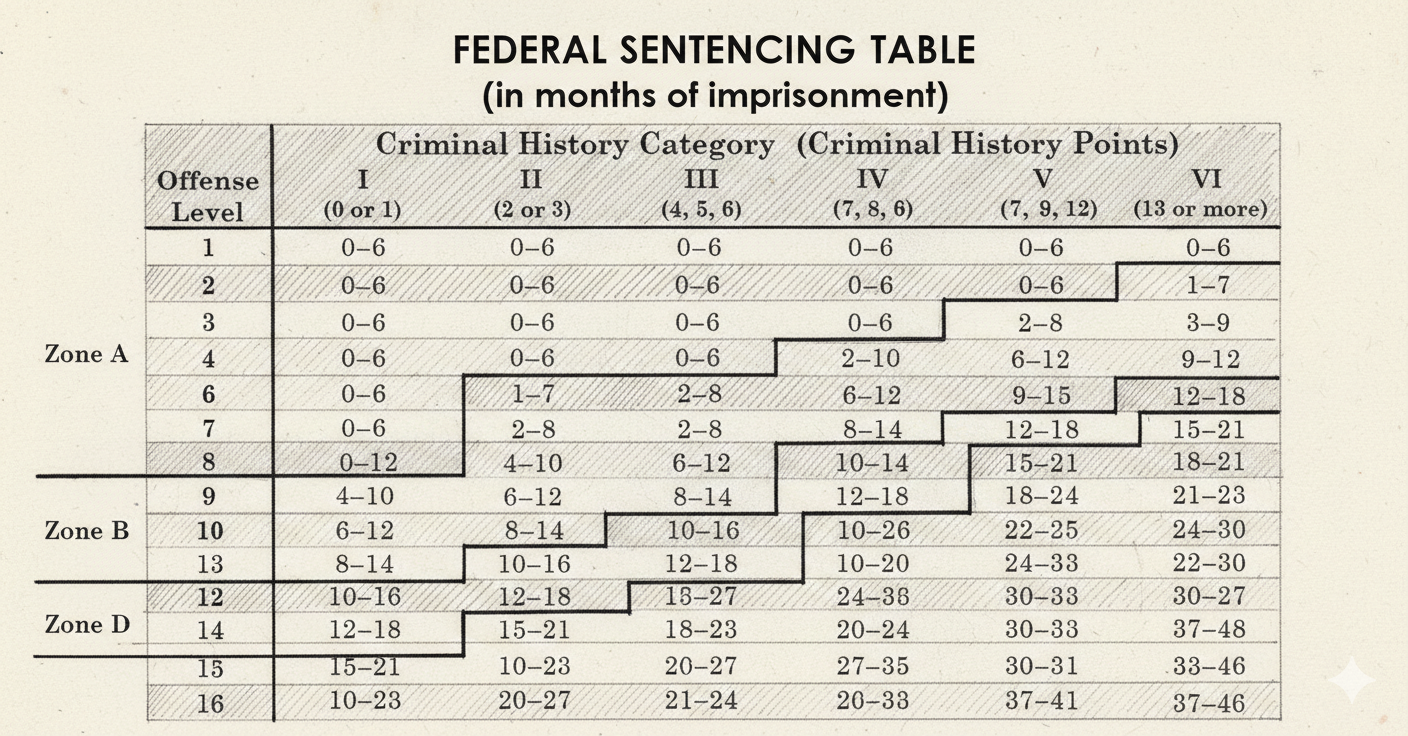
Guideline estimates for a defendant with no criminal history:
- Found to be a “Leader”: Level 28 (78–97 months)
- No Role Adjustment: Level 24 (51–63 months)
- Found to be “Minor”: Level 22 (41–51 months)
- Minor + Safety Valve: Level 18 (27–33 months)
Note: As you can see, the difference between being a “Leader” and a “Minor Participant” can effectively cut a sentence in half.
How Defense Counsel Builds Mitigating Role Arguments
A strong mitigating-role argument focuses on telling the defendant’s story with clarity and accuracy. The strongest factors include:
- Comparison to Co-Participants: We don’t compare you to the “average criminal.” We compare you to the specific people in your case. If they made the profit and called the shots, you should be Mitigating.
- Lack of Decision-Making Authority: Performing tasks without the power to decide how or when to do them suggests lower culpability.
- Financial Benefit: If you were paid a small flat fee while others took a percentage of the profits, this is strong evidence of a minor role.
- Limited Knowledge: Proving you didn’t know the full scope of the conspiracy (e.g., you didn’t know where the money came from or where the drugs were going).
What You Should Do If You’re Concerned About a Role Adjustment
Role adjustments are not mechanical calculations. They are arguments. They require evidence, context, and a deep understanding of the Guidelines, including recent changes like Amendment 794 and the Zero-Point Offender rules.
If you believe prosecutors are trying to frame you as a leader—or if you think you deserve a minor role reduction—you should address the issue immediately. The earlier a defense lawyer gets involved, the better positioned you’ll be to shape the narrative and protect your eligibility for critical reductions.
If you want help evaluating how role adjustments may affect your specific case, you’re welcome to ask for a deeper review tailored to your situation.
CALL US NOW for a CONFIDENTIAL INITIAL CONSULTATION at (305) 538-4545, or take a moment to fill out our confidential and secure intake form.* The additional details you provide will greatly assist us in responding to your inquiry.
*Due to the large number of inquiries we receive, providing specific details about your case helps us respond promptly and appropriately.
THERE ARE THOUSANDS OF LAW FIRMS AND ATTORNEYS IN SOUTH FLORIDA. ALWAYS INVESTIGATE A LAWYER’S QUALIFICATIONS AND EXPERIENCE BEFORE MAKING A DECISION ON HIRING A CRIMINAL DEFENSE ATTORNEY FOR YOUR MIAMI-DADE COUNTY CASE.